
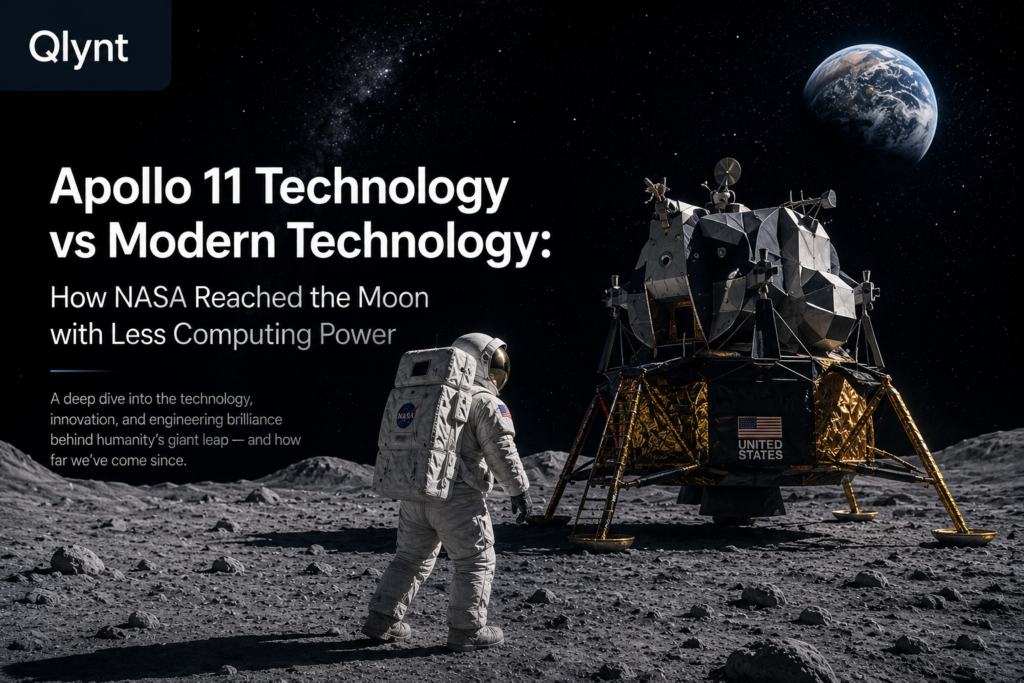
Apollo 11 technology represents one of the most audacious leaps in human history. On July 20, 1969, humanity achieved the impossible: landing two astronauts on the lunar surface and returning them safely to Earth. Today, people remain mesmerized by this mission, not just because of the sheer bravery of the astronauts, but because of the breathtaking engineering required to pull it off.
How did engineers in the 1960s navigate 240,000 miles of deep space using computers that possessed a fraction of the processing power of a modern musical greeting card? How does the technology of 1969 compare to the artificial intelligence, cloud networks, and reusable rockets we take for granted today?
This comprehensive guide explores every major technological marvel used in the Apollo 11 mission. From the roaring F-1 engines of the Saturn V to the woven core-rope memory of the Apollo Guidance Computer, we will break down the hardware and software that conquered the cosmos and compare it directly with the modern technology of today.
CHAPTER 1: The Story Behind Apollo 11
The Cold War and the Space Race
Apollo 11 was born out of geopolitical necessity. Following World War II, the United States and the Soviet Union entered the Cold War. Space became the ultimate high ground. When the Soviets successfully launched Sputnik in 1957 and sent Yuri Gagarin into orbit in 1961, the United States found itself trailing.
In response, President John F. Kennedy addressed Congress in May 1961, setting a staggering goal: “I believe that this nation should commit itself to achieving the goal, before this decade is out, of landing a man on the moon and returning him safely to the earth.” NASA’s objective was clear, but the technology required to achieve it did not yet exist.
Mission Timeline and Objectives
The primary objective of Apollo 11 was simple in concept but monumentally difficult in execution: perform a crewed lunar landing and return.
- Launch Date: July 16, 1969
- Lunar Landing Date: July 20, 1969
- Lunar Surface Time: 21 hours, 36 minutes
- Earth Return Date: July 24, 1969
The Crew
The mission was commanded by Neil Armstrong, a brilliant pilot and engineer known for his ice-cold demeanor under pressure. Buzz Aldrin, serving as the Lunar Module Pilot, brought a deep understanding of orbital rendezvous mechanics. Michael Collins, the Command Module Pilot, remained in lunar orbit, acting as the crucial link between the lunar surface and Earth.
Historical Significance
Apollo 11 proved that human ingenuity could overcome seemingly insurmountable physical and mathematical constraints. It pushed the boundaries of metallurgy, computing, telecommunications, and systems engineering, laying the foundation for the modern digital age.
Chapter 1 Summary: Apollo 11 was a Cold War mandate that pushed humanity to invent new paradigms in engineering, culminating in the successful lunar landing in July 1969 by Armstrong, Aldrin, and Collins.
CHAPTER 2: Technologies Used in Apollo 11
The success of NASA Apollo 11 relied on a vast network of interconnected, cutting-edge systems. Below is a detailed breakdown of the mission’s core technologies.
The Saturn V Rocket
To break free of Earth’s gravity, NASA needed a launch vehicle of unprecedented scale. Designed under the direction of Wernher von Braun, the Saturn V remains the tallest, heaviest, and most powerful rocket ever brought to operational status.
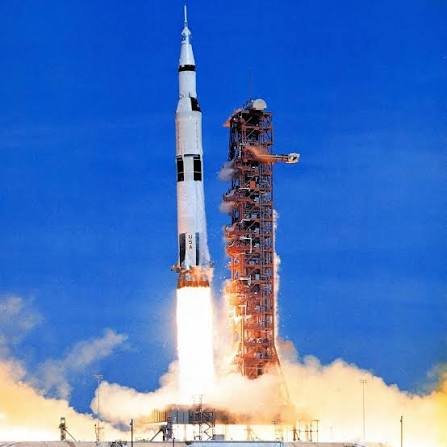
- Design and Stages: The rocket was divided into three stages (S-IC, S-II, and S-IVB). Staging allowed the rocket to shed dead weight as it consumed fuel, optimizing mass for the translunar injection.
- The F-1 Engines: The first stage utilized five massive F-1 engines burning RP-1 (highly refined kerosene) and liquid oxygen. Together, they generated an earth-shaking 7.5 million pounds of thrust.
- Comparison with Today: Today’s rockets, like SpaceX’s Falcon Heavy and Starship, prioritize reusability and utilize advanced methane-based fuels. However, the raw lifting power and flawless success record (13 out of 13 launches) of the Saturn V remain a gold standard in aerospace engineering.
Apollo Guidance Computer (AGC)
The Apollo 11 Computer is arguably the most famous computing system in history. Developed by the MIT Instrumentation Laboratory, the AGC was a masterpiece of miniaturization.
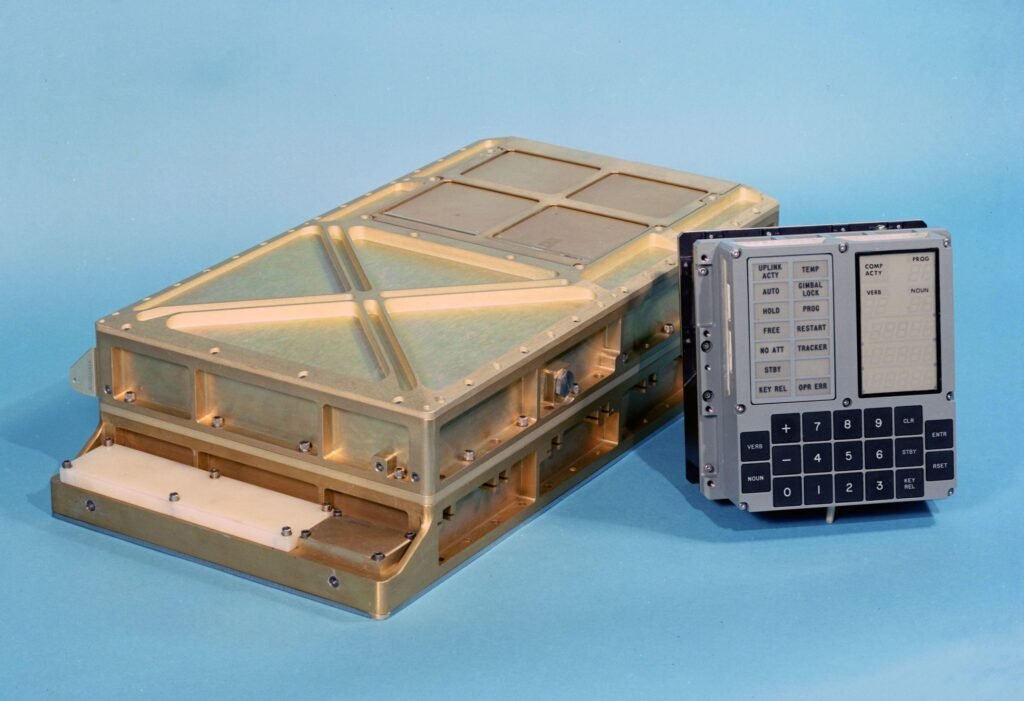
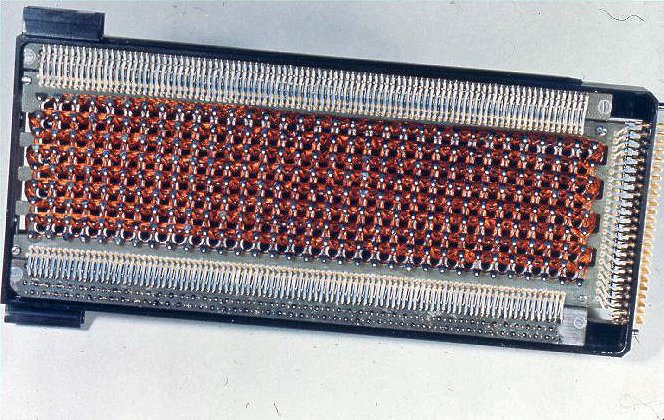
- Hardware and Specifications: The AGC operated at a clock speed of just 2.048 MHz. It had 2,048 words of RAM (magnetic core memory) and 36,864 words of ROM.
- Core Rope Memory: The ROM was physically woven by female textile workers. Wires passed through or around magnetic rings to represent 1s and 0s. This made the memory incredibly durable against radiation and vibrations, though impossible to alter once woven.
- The DSKY: Astronauts communicated with the computer using the Display and Keyboard (DSKY) interface, typing two-digit “Verb” (action) and “Noun” (object) codes.
- Modern Comparison: A modern smartphone has millions of times more memory and operates at clock speeds thousands of times faster. An iPhone processor can handle trillions of operations per second, whereas the AGC handled about 85,000.
Navigation Technology
Navigating to a moving target 240,000 miles away required absolute precision. The Apollo Navigation System relied on a combination of ground tracking and onboard autonomy.
- Inertial Measurement Unit (IMU): The heart of the navigation system was a gimbaled IMU containing gyroscopes and accelerometers to track the spacecraft’s orientation and velocity without outside references.
- Optical Navigation: Astronauts used a sextant to take sightings of specific stars relative to the Earth or Moon’s horizon, manually updating the computer’s positional data.
- Modern Comparison: Today, spacecraft heavily rely on GPS (in low Earth orbit), autonomous star trackers with digital catalogs, and AI-driven navigation that eliminates the need for manual sextant readings.
Communication Technology
Staying in touch with Apollo 11 required the Deep Space Network (DSN), a global web of massive radio antennas in California, Spain, and Australia.
- Unified S-Band: Apollo utilized a single radio frequency band to carry voice, telemetry (data about the ship’s health), and television signals simultaneously.
- Signal Delay: Because of the vast distance, radio waves traveling at the speed of light took about 1.25 seconds to reach the Moon, resulting in a noticeable delay in conversation.
- Modern Comparison: Modern systems use high-bandwidth Ka-band and experimental laser optical communications, allowing for 4K video streams from space, compared to the ghostly, low-frame-rate SSTV footage of 1969.
Lunar Module Technology
The Lunar Module (LM), built by Grumman, was the first true spacecraft—designed to fly only in the vacuum of space, allowing for an incredibly fragile, un-aerodynamic design.
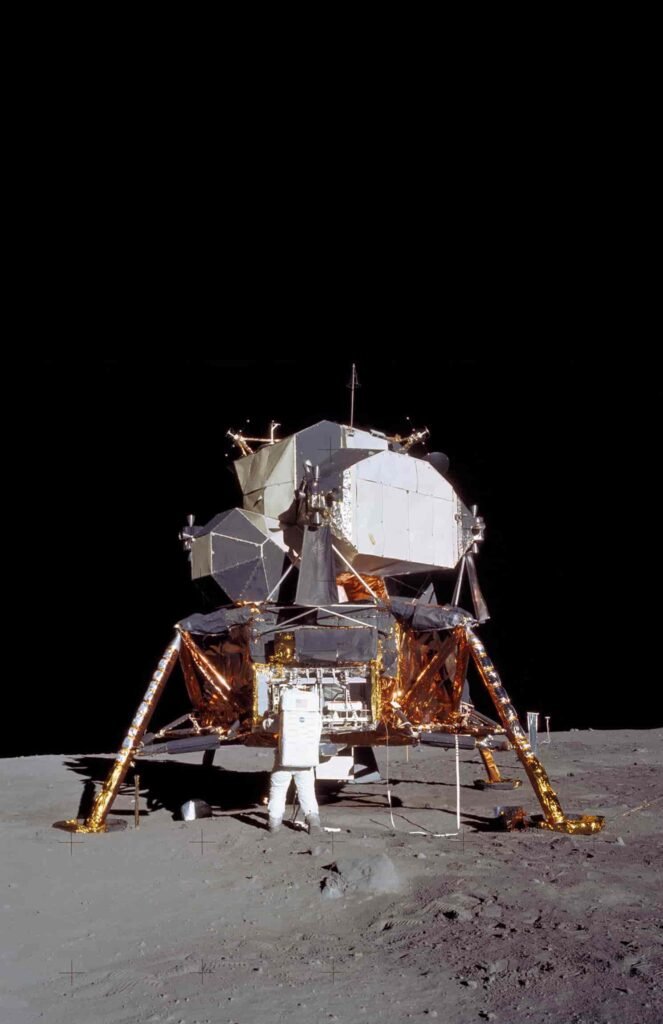
- Construction: To save weight, the LM was built with aluminum alloys so thin that an astronaut could accidentally punch a hole through the wall.
- Descent and Ascent: It featured two distinct stages. The descent stage used a throttleable engine (a massive innovation at the time) and landing radar. The ascent stage acted as the crew cabin and used a hypergolic engine—fuel that ignites on contact—eliminating the need for complex, heavy ignition systems.
- Modern Comparison: Modern landers feature autonomous hazard-avoidance cameras, advanced carbon composites, and reusable engines.
Space Suits
The Apollo A7L space suits were essentially human-shaped, wearable spacecraft.
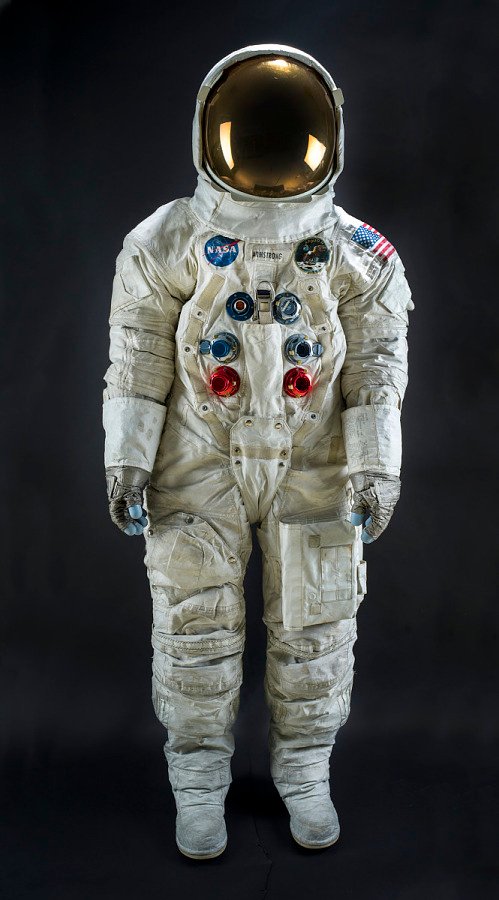
- Life Support: The Portable Life Support System (PLSS) backpack provided oxygen, removed carbon dioxide, and regulated temperature.
- Cooling: Because the lunar vacuum provides no heat dissipation, the suits used a Liquid Cooling and Ventilation Garment (LCVG)—a network of tubes pumping cool water across the astronaut’s skin.
- Modern Comparison: Today’s Artemis space suits (the xEMU) offer vastly improved mobility, particularly in the lower torso and joints, and use regenerative life support systems that require less maintenance.
Apollo Software and Margaret Hamilton
The software of Apollo 11 was just as critical as the hardware. Led by Margaret Hamilton, the MIT team practically invented modern software engineering.
- Priority Scheduling: The AGC used a real-time operating system that could prioritize tasks. When the computer became overloaded during the descent, it triggered the famous 1201 and 1202 alarms. Instead of crashing, the software dropped low-priority tasks (like radar updates) and focused solely on keeping the engines firing and the craft stable.
- Legacy: This fault-tolerant, asynchronous design is the direct ancestor of the operating systems running modern servers, aircraft, and medical devices.
Materials Used
- Metals and Insulation: The mission utilized advanced titanium and aluminum honeycomb structures. Thermal protection was achieved using Mylar, Kapton, and ablative heat shields that burned away to protect the Command Module during the 25,000 mph atmospheric reentry.
Chapter 2 Summary: Apollo 11 required bespoke solutions across rocketry, software, and materials. The Saturn V provided the muscle, the Apollo Guidance Computer provided the brains, and the Lunar Module served as the specialized vessel for the final descent.
CHAPTER 3: Apollo 11 vs Today’s Technology
To truly understand the marvel of the Moon Landing Technology, we must place it side-by-side with modern equivalents.
Computing and Processing
| Feature | Apollo Guidance Computer (1969) | Modern Smartphone (2020s) |
| Clock Speed | 2.048 MHz | 3.2 GHz or higher |
| RAM (Memory) | 4 Kilobytes | 8 to 16 Gigabytes |
| ROM (Storage) | 72 Kilobytes | 128 to 512 Gigabytes |
| Architecture | 16-bit word length | 64-bit multi-core |
| User Interface | Numeric DSKY interface | High-res OLED touchscreen |
| Weight | 70 pounds (32 kg) | 6 to 8 ounces (200g) |
Navigation and Software
| System | Apollo 11 (1969) | Modern Spacecraft (2020s) |
| Position Fixes | Manual optical sextant | Autonomous Star Trackers & GPS |
| Landing System | Radar and manual pilot override | AI-driven terrain relative navigation |
| Code Base | Assembly language on core rope | C++, Python, and modular frameworks |
| Error Handling | Hard-coded priority interrupts | Redundant failover cloud systems |
Engineering and Materials
| Component | Apollo Era (1960s) | Modern Era (2020s) |
| Rocket Engines | Expendable F-1 engines | Reusable Raptor/Merlin engines |
| Materials | Aluminum alloys and titanium | Carbon fiber and advanced composites |
| Manufacturing | Hand-machined parts | 3D printing and robotic assembly |
| Sensors | Analog gauges and rudimentary sensors | Millions of IoT digital data points |
Artificial Intelligence and Mission Planning
During Apollo, “automation” meant rigid, pre-programmed responses. Today, Artificial Intelligence and Machine Learning dominate space exploration. Modern rovers on Mars use AI to select targets for chemical analysis and navigate around boulders without Earth’s intervention.
Chapter 3 Summary: While modern technology boasts exponential increases in speed, memory, and autonomous AI capabilities, the logical architecture and fault-tolerant principles of the Apollo era remain the foundational bedrock of modern aerospace engineering.
$$Suggested Image Placement: A side-by-side graphical comparison of the Apollo DSKY interface and a modern glass-cockpit touchscreen display.$$
Caption: The evolution of spacecraft interfaces: from the numerical DSKY of 1969 to the digital touchscreens of the SpaceX Crew Dragon.
CHAPTER 4: How Apollo 11 Changed the Future of Technology
The phrase “space spinoff” exists primarily because of the Apollo program. The sheer volume of money and brainpower dedicated to the Moon Landing Technology accelerated human progress by decades.
- Integrated Circuits: Before Apollo, computers relied on bulky vacuum tubes or individual transistors. The Apollo Guidance Computer was the first major computer to use integrated circuits (microchips). NASA’s massive demand for these chips drove down prices, making them viable for consumer electronics and sparking the Silicon Valley revolution.
- Software Engineering: Margaret Hamilton coined the term “software engineering” during Apollo. The strict version control, testing protocols, and asynchronous processing developed for the AGC laid the groundwork for modern computer science.
- Digital Fly-by-Wire: The system used to control the Apollo spacecraft was adapted into aircraft. Today, almost all commercial airliners and fighter jets use digital fly-by-wire rather than heavy mechanical linkages.
- Medical Technology: The telemetry used to monitor Neil Armstrong’s heartbeat from 240,000 miles away was adapted into the intensive care monitoring systems used in hospitals today.
- Consumer Goods: Cordless tools, fire-resistant fabrics, and even memory foam trace their accelerated development back to the Apollo program.
Chapter 4 Summary: Apollo 11 was an economic and technological engine. The demand for reliable microchips and robust software directly catalyzed the personal computing revolution of the late 20th century.
CHAPTER 5: Apollo vs Artemis
As NASA prepares to return humans to the Moon, comparing the historical Apollo 11 mission with the upcoming Artemis program reveals how our approach to space exploration has evolved.
Mission Goals
- Apollo: A sprint to the Moon to prove technological superiority. Short stays with limited scientific payload.
- Artemis: Establishing a sustainable, long-term human presence on the Moon as a stepping stone to Mars.
The Hardware
- Rockets: Apollo’s Saturn V was a disposable powerhouse. The Artemis Space Launch System (SLS) is currently expendable, but the broader Artemis ecosystem heavily relies on reusable commercial rockets like SpaceX’s Starship for the Human Landing System (HLS).
- Space Suits: The Apollo suits were incredibly rigid when pressurized, forcing astronauts to “bunny hop.” The Artemis xEMU suits feature bearings at the waist, knees, and ankles, allowing astronauts to walk normally and kneel to pick up samples.
Computation and AI
While Apollo astronauts had to manually calculate burn times and update navigational coordinates using a sextant, Artemis astronauts fly in the Orion capsule—a fully automated, redundant, glass-cockpit spacecraft. Artemis relies on highly encrypted cloud computing and AI-driven telemetry analysis to monitor the spacecraft’s health, vastly reducing the cognitive load on the crew.
Chapter 5 Summary: Where Apollo was a magnificent, brute-force sprint using analog and early digital tech, Artemis is a marathon relying on sustainability, commercial partnerships, and autonomous AI systems.
CHAPTER 6: Interesting Facts Most People Don’t Know
Here are 20 surprising facts about Apollo 11 Technology and the mission itself:
- The Apollo 11 computer had less processing power than a standard USB-C charging cable does today.
- The F-1 engines on the Saturn V were so loud they could literally melt concrete and damage buildings miles away.
- The Lunar Module was so fragile that it would have collapsed under its own weight in Earth’s gravity.
- Neil Armstrong had to take manual control of the Lunar Module because the computer was guiding them into a boulder-filled crater.
- When the Eagle landed, there were only about 25 seconds of descent fuel remaining.
- The Apollo spacesuits were hand-sewn by seamstresses at Playtex, the bra and girdle manufacturer.
- The “core rope” memory was nicknamed “LOL memory” for “Little Old Ladies,” referring to the women who expertly wove it.
- There was a felt-tipped pen used to save the mission: Aldrin used a marker pen to engage a broken circuit breaker needed to fire the ascent engine.
- The Command Module’s heat shield reached temperatures over 5,000 degrees Fahrenheit during reentry.
- The 1202 program alarm meant the computer was overwhelmed, but thanks to priority scheduling, it never stopped flying the ship.
- Neil Armstrong’s famous transmission, “That’s one small step for man,” lost the “a” due to static or his fast speaking cadence.
- The astronauts left a silicon disc on the Moon containing goodwill messages from 73 world leaders.
- The Saturn V was not welded by robots; highly skilled human welders created the massive fuel tanks.
- The flag planted on the Moon was knocked over by the exhaust of the Lunar Module when the astronauts left.
- A specialized 16mm camera was used to capture the descent, running at just 6 frames per second to save film.
- The astronauts could not get life insurance, so they signed hundreds of postal covers before launch for their families to sell in case they died.
- Ground Control relied on massive IBM System/360 mainframes occupying entire floors to calculate orbital trajectories.
- The Lunar Module’s computer keypad (DSKY) used a heavy, glowing green electroluminescent display, not an LCD.
- Michael Collins was completely cut off from Earth communication for 48 minutes during every lunar orbit while behind the Moon.
- The dust on the Moon smelled like spent gunpowder, according to the astronauts after they took off their helmets inside the module.
CHAPTER 7: Lessons Modern Engineers Can Learn from Apollo 11
Despite the age of the Apollo 11 Technology, the engineering philosophy behind the mission remains highly relevant to today’s software developers, aerospace engineers, and AI researchers.
1. The Power of Fault Tolerance
Margaret Hamilton’s approach to the AGC software proves that systems shouldn’t be designed assuming nothing will go wrong. They must be designed to fail gracefully. In modern cloud architecture and cybersecurity, this translates to robust failovers and redundant microservices.
2. Relentless Testing
Apollo hardware underwent punishing thermal, vacuum, and vibration tests. Today’s “move fast and break things” software mentality is entirely inappropriate for life-critical systems. Apollo teaches the enduring value of extreme quality assurance.
3. Human-Centered Design
The DSKY interface was limited by hardware, but its Verb-Noun syntax was intuitive for the astronauts under intense stress. Modern UI/UX designers can learn from this: complex systems must present simple, actionable interfaces when the user is operating under pressure.
4. Collaborative Problem Solving
Mission Control was a triumph of teamwork. The decentralized but highly coordinated communication protocol allowed specialized experts in the “trenches” to feed accurate data up to the Flight Director rapidly.
Chapter 7 Summary: The technological limitations of the 1960s forced Apollo engineers to develop masterclasses in optimization, fault tolerance, and rigorous testing—principles that remain foundational in modern engineering.
FAQs
1. What technology did Apollo 11 use?
Apollo 11 used the Saturn V rocket, the Apollo Guidance Computer, the Lunar Module, specialized A7L space suits, and the Deep Space Network for communications. The systems relied heavily on mechanical engineering, early integrated circuits, and analog radio.
2. How powerful was the Apollo Guidance Computer?
The AGC had a clock speed of 2.048 MHz, 4KB of RAM, and 72KB of ROM. By today’s standards, it was incredibly weak, possessing less processing power than a modern smart appliance.
3. Could Apollo 11 technology land on the Moon today?
Technically, yes. The physics of orbital mechanics have not changed. However, it would be considered unacceptably risky by modern safety standards, and recreating the lost manufacturing techniques for analog parts would be immensely difficult.
4. How much RAM did Apollo 11 have?
The Apollo Guidance Computer used magnetic core memory with roughly the equivalent of 4 Kilobytes of RAM.
5. Why is Apollo 11 still considered an engineering masterpiece?
Because the engineers achieved a mathematically flawless deep-space rendezvous and landing using newly invented materials and computers that were built completely from scratch, without modern simulation software.
6. What was the 1202 program alarm?
It was an executive overflow alarm. The computer was receiving too much data from the rendezvous radar, but thanks to its brilliant software design, it dropped the low-priority tasks and kept the spacecraft flying.
7. How did they navigate to the Moon without GPS?
They used deep-space telemetry tracked by massive antennas on Earth, combined with an onboard Inertial Measurement Unit (gyroscopes) and an optical sextant used by astronauts to take star sightings.
8. What fuel did the Saturn V rocket use?
The first stage used RP-1 (highly refined kerosene) and liquid oxygen. The upper stages used liquid hydrogen and liquid oxygen.
9. How long did the Apollo 11 mission take?
The entire mission from launch to splashdown took roughly 8 days. The journey to the Moon took about 3 days.
10. What did Margaret Hamilton do for Apollo 11?
Margaret Hamilton was the Director of the Software Engineering Division at the MIT Instrumentation Laboratory. She led the team that developed the onboard flight software, pioneering asynchronous priority scheduling.
11. Did they have artificial intelligence on Apollo 11?
No. The computer executed precise, hard-coded routines. There was no machine learning or AI; the astronauts and ground control provided all the “intelligence.”
12. How heavy was the Saturn V rocket?
Fully fueled on the launch pad, the Saturn V weighed approximately 6.2 million pounds (2.8 million kilograms).
13. What were the spacesuits made of?
The A7L suits were constructed from multiple layers of materials, including nylon, Kapton, fiberglass cloth, Mylar, and Teflon-coated fiberglass to protect against micrometeoroids and temperature extremes.
14. How did Apollo communicate with Earth?
Through the Unified S-Band system, which packaged voice, telemetry, and television signals into a single radio wave transmitted to the Deep Space Network on Earth.
15. Is Artemis technology better than Apollo?
Yes. Artemis benefits from 50 years of advancements in materials science, digital computing, Artificial Intelligence, and highly efficient rocket engine designs, making it safer and more capable.
Conclusion
The Apollo 11 mission stands as an enduring monument to human capability. When we analyze Apollo 11 Technology against the backdrop of modern computing, artificial intelligence, and reusable rocketry, it is easy to view the 1969 hardware as primitive. However, raw computing power does not put humanity on the Moon—brilliant engineering does.
The engineers, seamstresses, mathematicians, and astronauts of the Apollo era faced a seemingly impossible mandate. Armed with slide rules, woven core rope memory, and boundless determination, they engineered highly optimized, fault-tolerant systems that flawlessly executed one of the most complex logistical operations in history.
Today’s technology—from the smartphone in your pocket to the GPS systems guiding global logistics—exists largely because the Apollo program forced humanity to invent the future. As modern engineers look toward Mars and beyond with the Artemis program, the foundational lessons of Apollo 11 remain: innovation is driven by intelligent design, rigorous testing, and the unyielding human desire to explore.


