
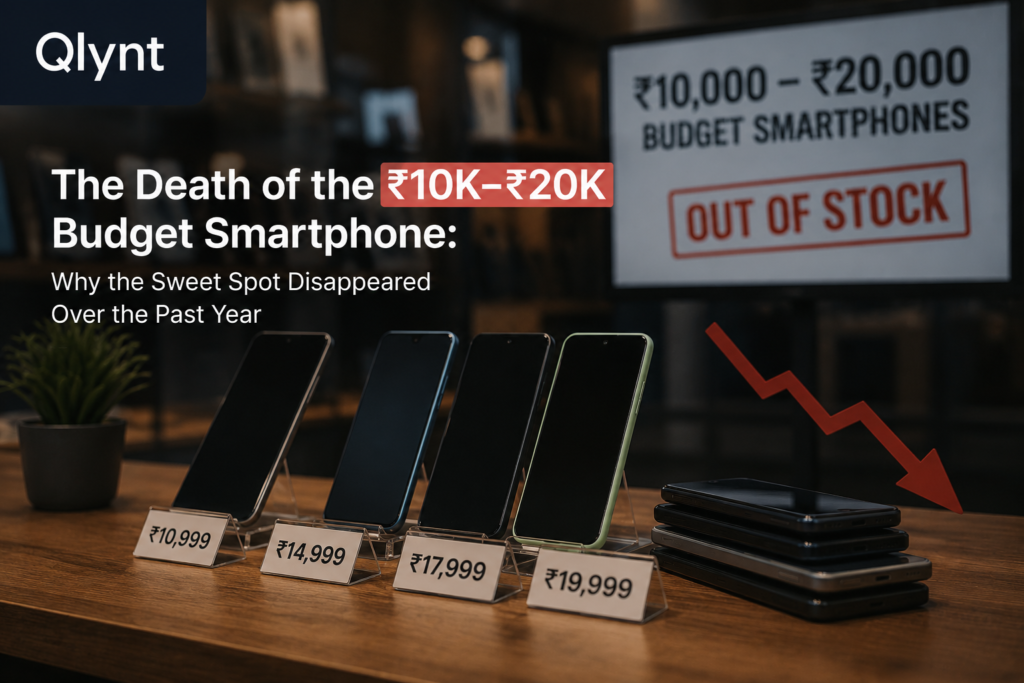
Meta Title: Is the ₹10,000–₹20,000 Budget Smartphone Dead? (2026 Tech Breakdown)
Meta Description: Why did the legendary ₹10K–₹20K segment vanish in India over the past year? Discover how the global AI server boom caused a massive chip crisis that destroyed budget mobile phones.
Remember when having ₹17,000–₹18,000 in your pocket meant you could buy a powerhouse mid-ranger? You didn’t just get a basic budget device; you got flagship killers like the Poco X-series or high-value Redmi Notes right at that price point.
Fast forward to 2026, and if you look at the ₹10,000 to ₹20,000 segment, the transformation is shocking.
This didn’t take ages to happen—the market flipped completely over the past 12 months. What used to be a premium mid-range budget experience has turned into a zone of heavy compromises. Brands are subtly moving their actual high-value phones beyond the ₹20,000 barrier, leaving the traditional sub-₹20k zone looking stripped and underpowered.
Let’s look at the deep structural reasons behind why this happened so quickly, starting with the massive shift in the global technology landscape.
The AI Squeeze: How Artificial Intelligence Killed Consumer Tech
The single biggest catalyst behind the sudden death of budget phones isn’t local inflation or minor tax hikes—it is a global phenomenon market analysts call “Chipflation,” directly triggered by the Silicon Valley AI boom.
Over the past year, tech giants like Microsoft, Google, Meta, and OpenAI have been locked in a ferocious race to expand their generative AI capabilities and build massive AI datacenters. To train and power these models, these hyperscalers require tens of thousands of specialized AI enterprise servers. The crucial component holding these servers together? High Bandwidth Memory (HBM) and high-capacity DDR5 RAM.
Because the enterprise AI sector offers astronomical profit margins compared to consumer electronics, the world’s three largest memory manufacturers—Samsung Electronics, SK Hynix, and Micron Technology—made a brutal strategic pivot. They reallocated their limited silicon wafer capacity and factory cleanroom space away from standard smartphones and toward high-margin AI chips.
This massive supply redirection triggered an absolute catastrophe for consumer hardware:
- The Price Shock: According to market research from firms like Counterpoint and SigmaIntel, mobile DRAM (RAM) prices skyrocketed by over 50–90% quarter-on-quarter, while NAND Flash (Storage) prices more than doubled over the past 12 months.
- The Bill of Materials (BOM) Crisis: In a standard budget smartphone, the RAM and storage configuration traditionally accounted for roughly 15% of the total cost to build the phone. Because of the AI squeeze, that exact same memory layout now devours up to 43% of the total manufacturing cost.
- The Industry-Wide Ripple: This isn’t just a mobile phone problem—the exact same AI-driven memory shortage recently forced Apple and Microsoft to implement price hikes of up to $300 on MacBooks, iPads, and gaming consoles.
With memory costs quadrupling since 2025, smartphone brands faced a dead end: they could no longer physically manufacture a phone with fast storage and high RAM under ₹20,000 without bleeding cash.
Macro Factors: The Rest of the Price Pressures
Beyond the AI memory crisis, two other major local factors sealed the fate of the ₹10K–₹20K price tier over the past year:
1. The Mandatory “5G Tax” & Rupee Depreciation
A year ago, brands could still get away with selling high-value 4G phones at lower tiers. Today, 5G is a mandatory consumer requirement in India. Integrating a competent 5G modem that supports a wide array of Indian network bands requires expensive licensing and physical engineering. Coupled with the depreciation of the Indian Rupee against the US Dollar, importing these essential chip components has become significantly more expensive for brands assembling phones locally.
2. The Rise of “Forced Premiumization” via No-Cost EMIs
Smartphone brands have realized that Indian consumers are changing how they pay. With the explosive growth of instant credit schemes, consumer financing, and No-Cost EMIs on platforms like Amazon and Flipkart, buyers are less price-sensitive at checkout. A customer who walks in with a rigid ₹16,000 budget can easily be convinced to buy a ₹23,000 phone because the monthly installment increase is minimal. Realizing this, brands intentionally stripped down the sub-₹20k tier to force buyers to upgrade to the higher, more profitable margin brackets.
The 12-Month Reality Check: Same Specs, Higher Price Tags
The shift is incredibly obvious when you track how pricing moved for similar hardware packages over the last year.
| Feature Category | What You Got Under ₹20k Last Year | What It Costs You Today (2026) |
| Performance (e.g., Dimensity 7300 / Snapdragon 7s Gen 2) | Cleanly available at ₹18,000–₹19,999 base | Pushed directly to ₹22,000–₹24,999 |
| Display (120Hz Curved pOLED / AMOLED) | Standard inclusion in top mid-rangers under ₹20k | Mostly stripped for flat, thick-bezel LCDs or basic screens |
| Charging & Battery | 67W–80W fast charging with brick in the box | Slipped down to 33W, or the charger is sold separately |
Real-World Examples: The Smartphones Defining the Shift
To see this dynamic in action, we just need to look at what is sitting on the shelves right now. The market has split into two types of phones: compromised devices trying to fit under the old ₹20k budget, and the actual budget kings that broke the price ceiling.
The Over-Budget Survivors (Real Value Pushed Above ₹20k)
These are the phones that carry the true spirit of the old budget kings—but they couldn’t keep the price tag down:
- Poco X6 / X7 Series: The base variant of the classic value champion has steadily climbed up. While it gives you a stunning 1.5K display and great performance, it now sets you back ₹21,999+, officially leaving the budget bracket.
- Redmi Note 14 Series: The absolute default recommendation for millions of users now starts well above the threshold, sitting firmly in the mid-range territory for the variants that actually matter.
The Sub-₹20k Standouts (Surviving with Cuts)
If you strictly refuse to go over ₹20,000, these are the primary choices remaining, but each comes with an intentional cost:
- CMF Phone 1: Sitting right around ₹15,999, it brings a powerful MediaTek Dimensity 7300 chip and a great AMOLED screen. However, it keeps costs low by stripping away basic essentials—there is no charger in the box, no headphone jack, and a single mono speaker.
- Moto G85 5G: Retailing around ₹15,999 to ₹17,999, it manages to offer a beautiful curved pOLED display and premium design, but relies on a modest Snapdragon 6s Gen 3 processor, which limits heavy gaming performance.
- OnePlus Nord CE 4 Lite: Priced right at the ceiling of ₹19,999, it brings a brilliant AMOLED display but recycles the older Snapdragon 695 processor, meaning performance hasn’t advanced from mid-range phones launched two years ago.
Final Verdict: The New “Real” Budget
The ₹10k–₹20k budget segment isn’t physically empty, but its identity is completely gone. According to market analysts, this component inflation pressure is going to last well into late 2027 or 2028 before new semiconductor fabs can come online. If you want a phone that truly feels modern, handles multitasking seamlessly, and lasts you three years without slowing down, ₹22,000 is the new ₹15,000.


