
Prompting vs Looping: Differences, Pros, Cons & Complete Guide
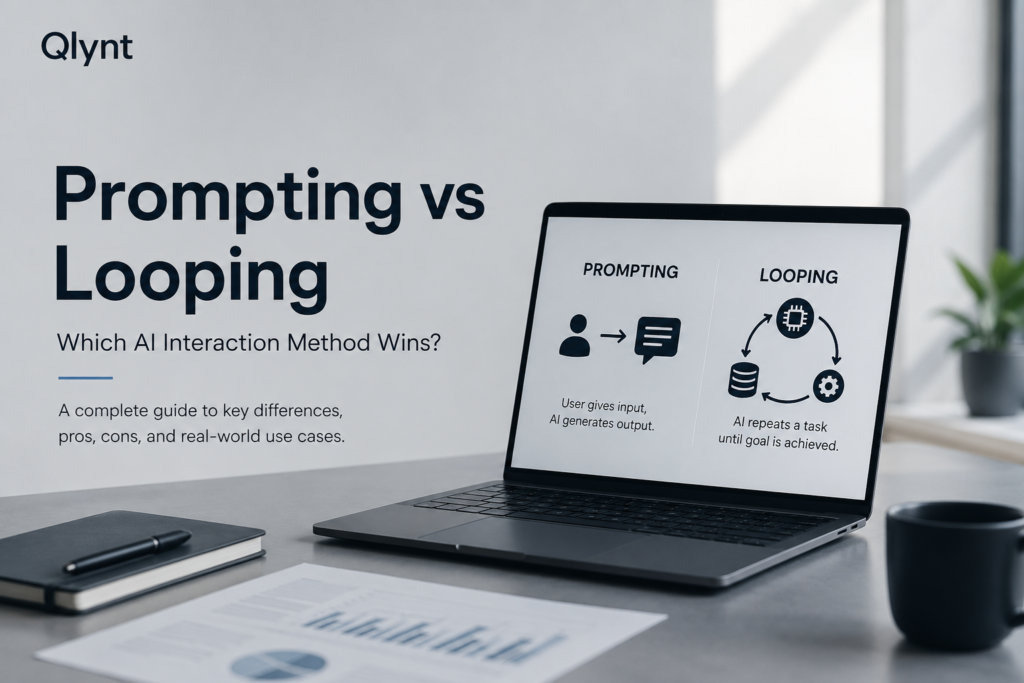
Prompting vs Looping is changing the way we interact with Artificial Intelligence. This guide explains the differences, history, advantages, disadvantages, and real-world use cases.
Introduction
The way we interact with artificial intelligence is undergoing a monumental shift. Just a few years ago, mastering Generative AI meant mastering the art of the prompt. We learned how to carefully structure our requests, assign personas to large language models (LLMs), and feed them exact context to get the desired output. However, as we navigate through 2026, the landscape of AI interaction has fundamentally transformed. We are no longer just talking to AI; we are deploying it.
This shift has brought a new heavyweight contender to the arena: AI Looping. While prompting remains the foundational language of human-AI communication, looping has emerged as the engine powering Agentic AI and autonomous workflows.
Why is this comparison so critical right now? Because the stakes have never been higher for businesses, developers, and AI enthusiasts. The models have grown more capable, but their ability to reason, self-correct, and execute multi-step tasks without human intervention relies entirely on how they are structured to interact with their environment.
Prompting is changing rapidly. What used to require incredibly complex, paragraph-long “jailbreaks” or hyper-specific instructions can now be handled by models that natively understand nuance. Meanwhile, looping has skyrocketed in popularity because it solves the biggest historical limitation of LLMs: the inability to reflect on mistakes. By wrapping an LLM in a cognitive loop—allowing it to plan, act, observe, and adjust—we unlock systems capable of conducting deep research, writing enterprise-grade software, and automating end-to-end customer support.
Understanding whether to use a straightforward prompt or to build an intricate agentic loop is the defining skill for AI automation builders today. In this comprehensive guide, we will dissect both methods, trace their evolutionary history, compare their enterprise viability, and definitively answer which interaction method takes the crown in 2026.
The Complete History: From Prompts to Loops
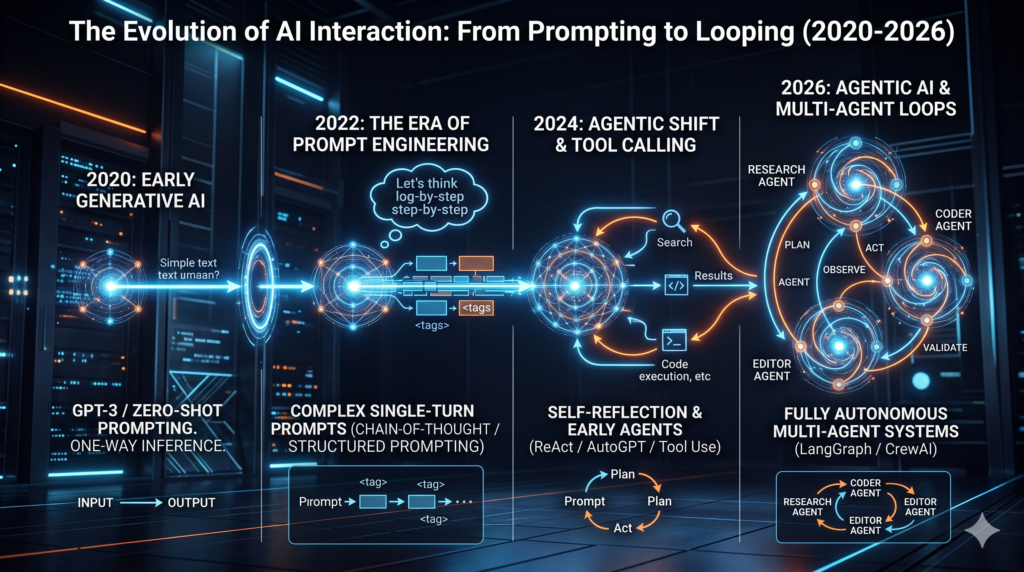
To truly understand where we are in 2026, we must look at the rapid evolutionary timeline of AI interaction. The journey from basic prompting to sophisticated autonomous looping is a story of continuous problem-solving by researchers and developers worldwide.
The Era of Prompting (2020 – 2022)
Prompting, as we know it, officially took the global stage with the release of OpenAI’s GPT-3 in 2020. Before this, interacting with AI was largely reserved for data scientists fine-tuning models with thousands of examples. GPT-3 introduced the concept of Zero-shot prompting, where an AI could perform a task it wasn’t explicitly trained for, simply based on instructions in plain English.
Shortly after, researchers discovered Few-shot prompting (Brown et al., 2020), proving that providing a model with two or three examples of a desired output drastically improved its performance.
The next major breakthrough came in 2022 with the introduction of Chain-of-Thought (CoT) prompting by researchers at Google (Wei et al., 2022). By simply adding the phrase, “Let’s think step by step,” the model was forced to break down its reasoning into intermediate steps before generating a final answer. This dramatically reduced logical errors in math and reasoning tasks. Around this time, Role prompting (“Act as a senior developer…”) also became a standard industry practice, birthing the formal discipline of Prompt Engineering.
The Dawn of Looping and Agentic AI (2023 – 2024)
While prompting was powerful, it was inherently limited. If the AI made a mistake in step one of a complex prompt, the entire output was ruined. The AI could not “go back” and fix it.
This limitation sparked the creation of AI loops. The paradigm shifted with the ReAct (Reasoning and Acting) framework (Yao et al., 2022), which allowed an LLM to alternate between thinking about what to do, acting (e.g., searching the web), and observing the result.
In early 2023, the world saw the explosive rise of open-source projects like AutoGPT and BabyAGI. These systems utilized primitive loops: they were given a primary goal, and they would recursively write their own prompts to generate tasks, execute them, and evaluate the results. Though early versions often got stuck in infinite loops, they laid the groundwork for autonomous agents.
Simultaneously, the concept of Self-reflection gained traction. Papers like Reflexion (Shinn et al., 2023) demonstrated that if you loop an AI’s output back into a “critic” prompt, the AI could evaluate its own work and rewrite it, drastically reducing hallucinations.
The Refinement of the Loop (2025 – 2026)
By 2025, the industry moved away from fragile, infinite-loop agents toward structured, deterministic workflows. Frameworks like LangGraph and CrewAI became enterprise standards. They allowed developers to map out complex business processes as cyclic graphs, where specialized agents passed data in controlled loops.
Simultaneously, model creators began baking loops directly into the neural architecture. The rise of Reasoning Models (like OpenAI’s o-series and Google’s Gemini reasoning iterations) internalized the loop. These models perform internal recursive “thinking” loops before ever streaming a single token to the user, effectively blurring the line between prompt and loop at the model level.
What is Prompting?
Prompting is the act of providing a natural language instruction, question, or context to a Generative AI model to elicit a specific response. It is a one-way, single-turn interaction. You throw the ball; the AI catches it and throws it back. The transaction is complete.
Despite the rise of autonomous agents, prompting remains an incredibly deep and nuanced discipline in 2026. Let’s break down the core types of prompting that drive today’s AI systems.
Simple Prompting
This is the baseline. A user asks a direct question (e.g., “What is the capital of France?” or “Write a polite rejection email”). The AI relies entirely on its pre-trained weights to generate the answer. It is fast, cheap, and effective for basic tasks.
Structured Prompting
For enterprise applications, prompts must be rigid. Structured prompting involves using specific formats—like Markdown, JSON, or XML tags—to force the AI to return data in a machine-readable way.
Example:
<instruction>Extract the invoice total.</instruction>
<format>Return ONLY a valid JSON object with the key 'total'.</format>
System Prompts
A system prompt operates behind the scenes, setting the fundamental guardrails, tone, and operational boundaries for an AI session. It tells the AI how to behave before the user even types a word. In 2026, system prompts for enterprise chatbots are often thousands of tokens long, detailing company policies, tone guidelines, and safety constraints.
Role Prompts
By assigning a persona (“You are a Stanford-educated astrophysicist explaining gravity to a 10-year-old”), you anchor the LLM’s vast latent space to a specific subset of vocabulary and tone. This dramatically improves the contextual relevance of the output.
Context Prompts (RAG)
In modern applications, prompts are rarely typed entirely by a human. Through Retrieval-Augmented Generation (RAG), a user’s short query is appended with massive amounts of retrieved database context before being sent to the LLM.
Multi-step Prompts
Also known as prompt chaining within a single inference call, this involves outlining a sequence of operations for the AI to follow linearly. (“Step 1: Read the text. Step 2: Summarize it. Step 3: Translate the summary to Spanish.”)
Pros of Prompting
- Speed: Near-instantaneous response times (low latency).
- Cost-Efficiency: You only pay for a single API call (input + output tokens).
- Simplicity: Easy for beginners and non-technical staff to learn.
- Predictability: Easier to reproduce results across the same model.
Cons of Prompting
- Fragility: A slight change in phrasing can drastically alter the output.
- No Self-Correction: If the AI hallucinates early in the response, the rest of the output is compromised.
- Context Limits: Even with massive context windows, a single prompt can only juggle so many instructions before “lost in the middle” phenomena occur.
Best Use Cases
Content drafting, code snippet generation, document summarization, translation, structured data extraction, and general Q&A.
Industries Utilizing Prompting
Marketing (copywriting), Legal (contract summarization), Education (tutoring chatbots), and basic Customer Support (FAQ bots).
What is Looping?
If prompting is a single throw and catch, looping is a continuous game of tennis played by the AI with itself, its environment, or external tools until the match is won.
Looping in AI (often referred to as Agentic Looping) is an architectural framework where an LLM is placed inside a programmatic cycle (like a while loop in software engineering). The AI generates an output, that output is evaluated or executed, the result is fed back into the AI as new context, and the AI tries again or moves to the next step.
Let’s explore the specific types of loops dominating AI in 2026:
Iterative Prompting Loops
The simplest form of looping. An AI generates a draft, a secondary “critic” prompt reviews the draft against a rubric, and the original AI uses the critique to write a second version. This loop runs a set number of times (e.g., 3 iterations) before presenting the final result to the human.
Reflection Loops
Rooted in the Reflexion framework, these loops are designed for problem-solving. If an AI coding agent writes a script and it throws an error when run, the error log is captured and fed back into the AI. The AI “reflects” on why the error occurred, writes a fix, and runs it again.
Planning & Execution Loops
This is the core of modern Agentic AI. The loop starts with a high-level goal.
- Plan: The AI breaks the goal into a checklist.
- Execute: The AI tackles item #1 using tools (web search, calculator, API call).
- Observe: The AI looks at the result of the tool use.
- Update: The AI crosses item #1 off the list, adjusts the plan if necessary, and loops back to execute item #2.
Memory Loops
In advanced enterprise systems, loops interact with Long-Term Memory (vector databases or graph databases). After every interaction, a loop runs to summarize the conversation, extract key user preferences, and update the memory bank, ensuring the AI “remembers” context across days or weeks.
Evaluation Loops
Used heavily in AI alignment and testing (LLM-as-a-Judge). An AI continuously generates synthetic data or test cases, runs them through another model, evaluates the output, and adjusts the prompt dynamically until a high accuracy threshold is met.
Pros of Looping
- High Accuracy & Reasoning: Capable of solving incredibly complex, multi-layered problems.
- Self-Correction: Errors are treated as feedback rather than failures, allowing the AI to auto-correct.
- Autonomy: Can operate for minutes, hours, or days without human intervention.
- Tool Mastery: Loops allow AI to use software APIs exactly like a human would (try, fail, read documentation, fix, succeed).
Cons of Looping
- Cost: Running an LLM recursively through a loop consumes massive amounts of tokens, driving up API costs significantly.
- Latency: A user might have to wait several minutes for an agent loop to finish its task.
- Complexity: Building stable loops requires advanced software engineering (handling infinite loops, context window overflows, and API rate limits).
Best Use Cases
Autonomous software engineering (e.g., Devin, Cursor), automated scientific research, complex data analysis, autonomous cybersecurity penetration testing, and multi-platform marketing orchestration.
Industries Utilizing Looping
Software Development, Financial Modeling, Cybersecurity, Healthcare Research, and Supply Chain Automation.
Prompting vs Looping: Detailed Comparison
To fully grasp which method wins, we must compare them across various technical and business metrics. Here is the definitive 2026 comparison table.
| Metric | AI Prompting | AI Looping (Agentic AI) |
| Learning Curve | Low. Anyone can learn to write good prompts in a few hours. | High. Requires understanding of software architecture, state management, and orchestration frameworks (LangChain, LangGraph). |
| Speed (Latency) | Very Fast. Responses are usually streamed back in seconds. | Slow. Multi-step reasoning and API calls can take minutes to complete. |
| Accuracy | Moderate. Highly dependent on initial context; prone to single-point failure. | Very High. Self-correction mechanisms catch and fix errors before the user sees them. |
| Token Usage | Low. One input, one output. | Extremely High. The context window grows with every iteration of the loop. |
| Cost | Very Low. Pennies per interaction. | High. Can cost dollars per task depending on the model and loop depth. |
| Automation Level | Low to Moderate. Requires a human to initiate and usually a human to review. | High. Can run autonomously in the background, executing complex SOPs. |
| Creativity | High. Great for brainstorming, drafting, and lateral thinking. | Moderate. Best suited for deterministic tasks, logic, and reasoning over pure creative flow. |
| Reasoning Capability | Shallow. The model is guessing the next token linearly. | Deep. Mimics human System 2 thinking (planning, executing, reflecting). |
| Complexity Handled | Low to Medium. Struggles with tasks requiring more than 4-5 dependent steps. | Very High. Built specifically for tasks with dozens of unpredictable steps. |
| Scalability | High (for simple tasks). Easy to deploy across millions of basic queries. | Moderate. Requires significant infrastructure (compute, databases) to scale widely. |
| Reliability | Moderate. Susceptible to hallucination and context drift. | High. Evaluation nodes within the loop act as strict guardrails. |
| Business Use Case | Customer service chatbots, content generation, quick coding help. | Autonomous QA testing, end-to-end research reports, self-healing code. |
| Developer Friendliness | High. Standard API calls. | Moderate. Requires dealing with asynchronous functions, state graphs, and agent routing. |
| Maintenance | Low. Updating a prompt takes seconds. | High. Maintaining tools, APIs, and node logic requires ongoing engineering effort. |
| Hallucination Control | Low. Must rely on model alignment and RAG. | High. Critic agents and reflection nodes verify facts before final output. |
| Human Effort | High active effort (requires constant back-and-forth steering). | Low active effort (set the goal and walk away), high upfront setup effort. |
| Enterprise Adoption | Universal. Every company uses basic prompting via ChatGPT or Copilot. | Growing rapidly in Fortune 500s for backend operational automation. |
| Future Scope | Will remain the primary interface layer for human-AI interaction. | Will become the invisible engine powering the entire digital economy. |
Real-World Examples in 2026
To ground these concepts, let’s look at how the biggest players in the industry are utilizing both methods today.
Cursor AI & GitHub Copilot
- Prompting: When a developer highlights a block of code and types, “Explain what this does,” that is a pure prompt. The AI reads the code and replies instantly.
- Looping: In 2026, Cursor’s “Composer” or Copilot’s “Workspace” features use looping. You write, “Build a user authentication system.” The AI plans the files needed, writes the backend, writes the frontend, runs a test, sees a database connection error, loops back to fix the environment variables, and presents a finished, working feature.
Perplexity AI
- Prompting: “What is the weather in Tokyo?” Quick prompt, quick retrieval, single answer.
- Looping: Perplexity’s “Pro Search” or “Deep Research” uses loops. It breaks down a complex query, searches multiple sources, reads the pages, realizes it needs more specific data, searches again, synthesizes the findings, and writes a comprehensive report.
Anthropic (Claude)
Anthropic’s introduction of Computer Use relies heavily on loops. If you ask Claude to “Book me a flight to New York,” it uses a vision-action loop. It looks at the screen (observe), moves the mouse to open a browser (act), looks at the search results (observe), clicks the right flight (act). This continuous loop allows it to navigate chaotic GUI environments.
Google Gemini
Google utilizes hybrid approaches. Standard Gemini uses complex RAG prompting to search your Google Drive. However, Google’s advanced data analysis tools use a loop: they write a Python script based on your prompt, execute it on Google Cloud, review the resulting chart, and if the chart is formatted poorly, rewrite the code before showing you the result.
Customer Support AI (Intercom, Zendesk)
- Prompting: A bot recognizes a question about refund policies and retrieves the exact paragraph from the knowledge base.
- Looping: An autonomous support agent receives a ticket about a lost package. It queries the shipping API, sees the package is delayed, queries the inventory API to see if a replacement is available, creates a draft email, routes it through a compliance-check model, and then securely sends the email to the customer.
Advantages of Prompting
- Immediacy and Flow: Prompting keeps the human in the loop. It is a collaborative dance. When brainstorming marketing copy or exploring creative ideas, the instant feedback loop between human and machine is invaluable.
- Resource Efficiency: In an era where GPU compute is at a premium, prompting is incredibly lightweight. Businesses can process millions of prompt-based API calls for a fraction of the cost of running agentic loops.
- Low Barrier to Entry: You do not need to be a software engineer to be a world-class prompt engineer. Mastery of language, logic, and domain expertise is enough to extract massive value from LLMs.
- Deterministic Control: With strict structured prompting (like forcing JSON outputs), developers can easily pipe the results of an LLM directly into traditional software databases without fear of the model going rogue.
Advantages of Looping
- The End of the “Lazy AI”: Historically, if a prompt was too complex, the AI would skip steps or provide generic summaries. Looping forces the AI to execute every single sub-task diligently, tracking its progress against a state machine.
- Error Resilience: Looping fundamentally shifts AI from being a fragile glass cannon to a robust engine. If a web search fails, a looped agent doesn’t crash; it tries a different search engine.
- Asynchronous Productivity: Looping decouples human time from AI execution time. You can assign a task at 5:00 PM, and the looped agent will work iteratively overnight, presenting the final result at 9:00 AM.
- Complex Tool Orchestration: Loops allow AI to use multiple disparate tools seamlessly. An agent can pull data from Salesforce, format it in Excel, draft an email in Outlook, and send a summary to Slack—all within one continuous loop.
Disadvantages of Prompting
- The Context Ceiling: No matter how good your prompt is, asking a model to do 15 highly complex things in one go will result in cognitive degradation (hallucinations or forgotten instructions).
- Lack of Verification: A prompt relies on the model getting it right on the first try. There is no internal mechanism for the model to “double-check” its work against reality before displaying it.
- Prompt Drift: As underlying foundational models are updated by OpenAI or Anthropic, a highly optimized prompt that worked perfectly in January might perform poorly in March.
Disadvantages of Looping
- Infinite Loops & Token Burn: Without strict safeguards (like a
max_iterationslimit), a looping agent can get stuck in a logic loop, repeatedly failing a task and retrying, burning thousands of dollars in API credits in hours. - Debugging Nightmare: Tracing exactly where an agentic loop went wrong requires parsing through massive logs of internal agent dialogue, which can be highly complex for developers.
- Slower Time-to-Value: For a user seeking a quick answer, waiting 45 seconds for an agent to plan, execute, and reflect is a terrible user experience.
When Should You Use Prompting vs Looping?
The decision between prompting and looping in 2026 comes down to Task Complexity, Required Reliability, and Latency Tolerance.
Use Prompting When:
- You need an answer in less than 3 seconds.
- The task is generative and creative (writing a blog post, drafting an email).
- The task involves direct data extraction from provided text.
- You are building a conversational UI where human-like back-and-forth is the goal.
- Budget is a strict constraint.
Use Looping When:
- The task requires gathering information from multiple live external sources.
- The task involves writing, testing, and deploying code.
- Accuracy is non-negotiable (e.g., financial reporting, medical data synthesis).
- The process takes a human more than 30 minutes to complete.
- You are building a backend automation pipeline where the user does not need to see the AI “thinking.”
The Future of AI: Agents, MCP, and Beyond
So, which interaction method wins in 2026? The truth is, Looping is the undisputed winner for enterprise automation and high-level problem solving, but Prompting remains the indispensable user interface.
However, the future is rapidly evolving beyond these distinct categories. Here is where the industry is heading:
The Rise of True Multi-Agent Systems
We are moving from single loops to multi-agent orchestrations. Imagine an entire virtual corporate department. A “Researcher Agent” runs a loop to gather data, passes it to a “Writer Agent” who drafts the report, who passes it to an “Editor Agent.” If the Editor finds a flaw, it sends it back to the Writer. This is multi-agent looping, and frameworks like LangGraph are making this the standard enterprise architecture.
Internalized Model Reasoning (System 2 Thinking)
Models like OpenAI’s o-series are blurring the lines. They perform “Chain-of-Thought” looping internally at the hardware level. The user provides a simple prompt, and the model spends 30 seconds looping through possibilities, testing hypotheses internally, before outputting text. As these models get faster, external software loops may become reserved only for tool execution, while reasoning loops happen inside the black box.
Model Context Protocol (MCP)
Pioneered heavily in late 2024 and standardized by 2026, MCP is the missing link for looping. MCP acts as a universal API standard allowing AI agents to securely connect to local and remote data sources (Slack, GitHub, local file systems). MCP enables looping agents to effortlessly transition from reasoning about data to actually modifying real-world files securely.
Will Prompting Disappear?
No. Prompting is the steering wheel. Even the most advanced autonomous, looping spaceship needs a human to input the destination coordinates. The future of prompting will shift away from “tricking” the AI with prompt engineering hacks, and move toward Goal-Oriented Specification—defining clear acceptance criteria, safety boundaries, and high-level objectives for the looping agents to execute.
10 Common Myths and Facts
Myth 1: Prompt engineering is a dead career.
Fact: It has evolved. You no longer need to know “hacks,” but you must know how to write system prompts for complex agentic loops. System architecture is the new prompt engineering.
Myth 2: AI loops run completely autonomously without humans.
Fact: The best AI loops incorporate “Human-in-the-Loop” (HITL) nodes, pausing execution to ask a human for approval before taking high-stakes actions (like transferring money or sending a mass email).
Myth 3: Looping eliminates AI hallucinations completely.
Fact: Looping drastically reduces hallucinations through self-reflection, but if the “critic” agent also hallucinates, the loop can actually reinforce false information.
Myth 4: You need a different AI model for prompting vs looping.
Fact: The same foundational models (GPT-4o, Claude 3.5 Sonnet) can be used for both. It is the surrounding software architecture that creates the loop.
Myth 5: CoT (Chain-of-Thought) is the same as an Agent Loop.
Fact: CoT is a prompting technique to make the AI explain its reasoning in one output. An Agent Loop is a software architecture that allows the AI to take real actions over time.
Myth 6: Looping is too expensive for startups to use.
Fact: While token costs are higher, the ROI of replacing 10 hours of manual human research with 50 cents of looped AI API calls is massively profitable for startups.
Myth 7: Reasoning models (like OpenAI o1) make external loops obsolete.
Fact: Reasoning models are excellent at logic and math, but they still require external loops (LangGraph, AutoGen) to interact with external databases, APIs, and software environments continuously.
Myth 8: Longer prompts always yield better results.
Fact: Over-prompting often confuses the model. Clear, concise prompts combined with an iterative looping process yield much higher quality results than a single 5-page prompt.
Myth 9: Looping guarantees a better creative output (like poetry or art).
Fact: Looping can actually “over-sanitize” creative work. A critic agent might strip away the nuance and soul of a creative piece to make it perfectly align with a rubric. Prompting is usually better for pure art.
Myth 10: Setting up an AI loop takes months of engineering.
Fact: In 2026, visual node-based builders and mature frameworks allow developers to deploy robust agentic loops in a matter of days or even hours.
Expert Tips for 2026
Depending on where you sit in the AI ecosystem, your approach to prompting and looping should differ. Here is actionable advice for 2026:
For Developers & Engineers:
Stop focusing on zero-shot API calls. Learn LangGraph, LlamaIndex, or CrewAI. Master state management and asynchronous execution. Learn how to build robust “tools” (Python functions) that your loops can reliably call. Master error handling—ensure that when an API fails, your agent knows how to read the error and try a different approach.
For Business Owners & Executives:
Audit your workflows. If a task requires a human to copy data from one place, read it, and paste a summary elsewhere, build an AI loop. If a task requires nuanced customer empathy, stick to a human augmented with basic prompt-based retrieval tools. Budget for higher API costs, but measure it against the labor hours saved.
For Prompt Engineers:
Transition into “AI Systems Architects.” Your skill in writing precise instructions is now needed to write the System Prompts for individual specialized agents (e.g., writing the instructions for the “Code Reviewer Agent” inside a loop). Focus on learning JSON structured output prompting, as this is how agents communicate with each other.
For Students & Beginners:
Start with prompting. Learn how models “think” and where they fail. Once you understand the limitations of a single prompt, you will naturally understand why loops are necessary. Use tools like ChatGPT or Claude to practice iterative refinement before diving into code.
For Content Creators:
Use prompting for ideation, outlining, and drafting. Use iterative looping (via specialized tools or recursive prompting) for editing, fact-checking, and SEO optimization. Do not let loops write the final draft autonomously; the human voice is your primary differentiator in 2026.
Conclusion
As we look across the AI landscape in 2026, the debate between prompting and looping is not about one replacing the other; it is about utilizing the right tool for the job.
Prompting is the art of communication. It is the precise, immediate, and efficient way we steer Generative AI to assist us in our daily cognitive tasks. It remains the foundational bedrock of AI interaction, perfect for brainstorming, drafting, and rapid information retrieval.
Looping, on the other hand, is the engine of execution. It represents the shift from AI as a “chatbot” to AI as a “digital worker.” By empowering models with the ability to plan, act, reflect, and iterate autonomously, loops have unlocked enterprise automation at a scale previously thought impossible.
For beginners and everyday users, mastering the prompt is still the most vital step into the AI ecosystem. But for developers, automation builders, and business leaders looking to build the next generation of scalable software, agentic looping is the undeniable winner.
The future belongs to those who know how to write the perfect system prompt—and then have the engineering vision to wrap it in an autonomous loop.


